Affiliate Commission Structures: How to Set Rates That Attract Top Partners
Explore different commission structures — percentage, flat-rate, tiered, recurring, and hybrid — with SaaS industry benchmarks and strategies for sustainable rates.
Why Commission Structure Is Your Most Important Decision
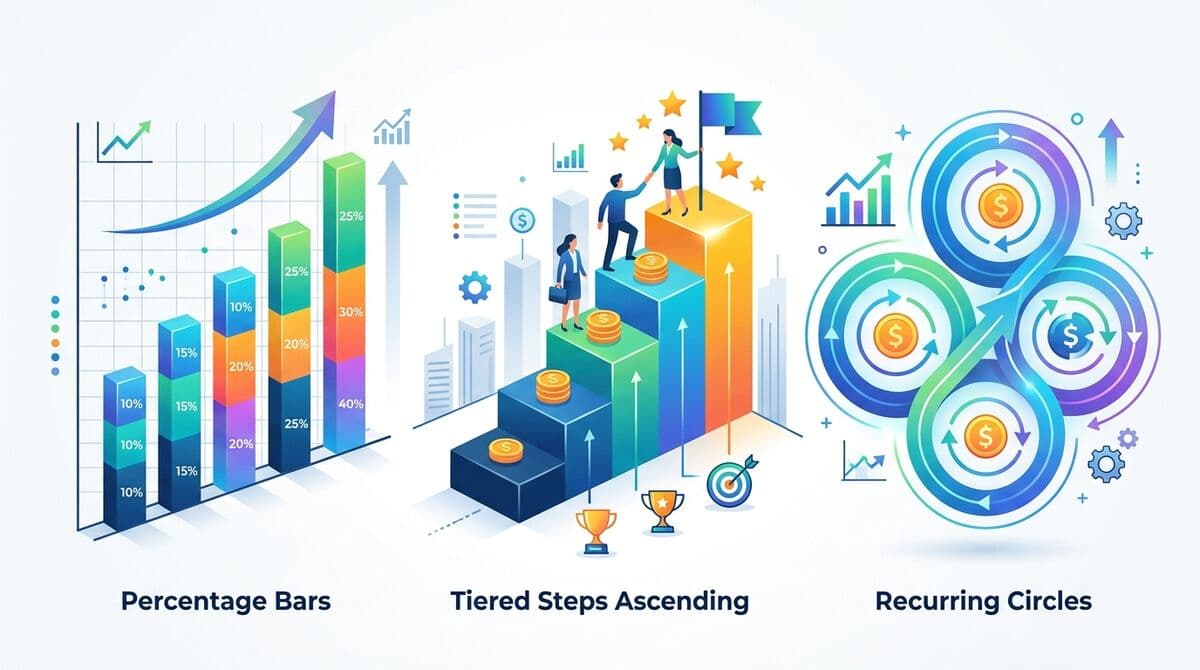
Percentage
30% per sale
Best for SaaS
Flat Rate
$50 per signup
Best for leads
Tiered
20% → 30% → 40%
Reward top performers
Recurring
20% monthly
Best for subscriptions
Your commission structure is the foundation of your affiliate program. It determines how much affiliates earn, which directly determines who is willing to promote your product. Get the structure right, and you attract high-quality partners who drive real customers. Get it wrong, and you either overpay for low-quality traffic or fail to attract anyone worth partnering with.
The commission structure also signals your program's seriousness. Professional affiliates evaluate dozens of programs before deciding where to invest their time. They look at commission rates first, but they also evaluate the structure — is it recurring? Are there tiers? Is there a minimum payout threshold? These details tell experienced affiliates whether your program is worth their effort.
Let us examine the most common commission structures, their advantages and disadvantages, and when each one makes sense for SaaS companies.
Percentage-Based Commissions
Commission Calculator
Sale Price
$149
/month
Commission Rate
30%
percentage
Commission
$44.70
/month recurring
Percentage-based commissions are the most common structure in SaaS affiliate programs. The affiliate earns a fixed percentage of every sale they refer — typically 15-30% of the subscription price.
How it works: If your product costs $49/month and you offer a 25% commission, the affiliate earns $12.25 for each monthly payment their referral makes. For annual plans at $490/year, the affiliate earns $122.50 per renewal.
Industry benchmarks for SaaS:
- Low-competition niches: 15-20% is competitive
- Medium-competition niches: 20-25% is the standard
- High-competition niches (email marketing, CRM, hosting): 25-40% is required to attract top affiliates
- Premium/Enterprise SaaS (high LTV): 10-20% is acceptable because the absolute dollar amounts are significant
Pros: Simple to understand and calculate. Automatically scales with your pricing — if you raise prices, affiliate earnings increase proportionally. Aligns affiliate incentives with your revenue.
Cons: Can be expensive for high-priced products. A 25% commission on a $299/month enterprise plan is $74.75/month — make sure your LTV supports this. Also, affiliates may push discounts to close sales, which reduces both your revenue and their commission.
Flat-Rate and Bounty Commissions
Flat-rate commissions pay a fixed dollar amount per conversion regardless of the sale value. This is common for lead generation programs and products with variable pricing that makes percentage-based commissions unpredictable.
How it works: You pay $50, $100, or $200 for every qualified signup or paid conversion. The amount does not change based on which plan the customer selects.
When flat-rate works for SaaS:
- Usage-based pricing: If your pricing varies widely based on usage (like cloud infrastructure or API calls), a flat bounty is simpler than trying to calculate a percentage of a variable amount.
- High-value enterprise sales: For enterprise products with $1,000+/month contracts, a flat bounty of $500-$1,000 per deal can be more predictable than a percentage.
- Freemium conversion: Pay a bounty only when a free user converts to a paid plan, regardless of which plan they choose.
Pros: Predictable costs for you. Simple for affiliates to understand their earning potential. You can adjust the bounty independently of your pricing.
Cons: Does not scale with customer value. An affiliate who refers a customer to your $299/month plan gets the same bounty as one who refers a $39/month customer. Also, flat-rate bounties do not create the ongoing income stream that motivates affiliates to keep promoting your product long-term.
Tiered Commission Structures
Tiered Commission Structure
0–10 sales
11–50 sales
51–100 sales
100+ sales
Higher volumes unlock better commission rates, motivating top affiliates
Tiered commissions reward volume by increasing the commission rate as affiliates hit performance milestones. This structure creates a natural incentive for affiliates to invest more effort in promoting your product.
Example tier structure:
- Tier 1 (0-10 sales/month): 20% commission
- Tier 2 (11-25 sales/month): 25% commission
- Tier 3 (26-50 sales/month): 30% commission
- Tier 4 (50+ sales/month): 35% commission
Some programs apply the higher rate only to sales above the threshold (incremental tiers), while others apply it retroactively to all sales in the period (retroactive tiers). Retroactive tiers are more motivating but more expensive.
Pros: Rewards your best performers and creates a game-like progression that keeps affiliates engaged. Your average commission rate stays lower because most affiliates will be in the lower tiers. Top performers get premium rates that make them less likely to switch to competitor programs.
Cons: More complex to manage and explain. Can discourage new affiliates who see the top-tier rates but realize they are far from reaching them. Requires careful financial modeling to ensure the top tiers are sustainable.
Tiered structures work best for programs with a mix of affiliate types — casual promoters in the lower tiers and professional affiliates who can realistically reach the higher tiers. Icodrip supports custom tier configurations so you can design the structure that fits your program.
Recurring vs One-Time: The SaaS Decision
One-Time vs Recurring Commission Value
$50
total after 12 months
$600
12x more over 12 months
For SaaS companies, the choice between recurring and one-time commissions is perhaps the most consequential structural decision. Here is the honest comparison:
One-time commissions pay once when the customer first converts. They are simpler to manage and have a capped cost per acquisition. A $100 one-time bounty for a SaaS signup is predictable and finite. However, one-time commissions do not leverage the key advantage of SaaS — recurring revenue. Affiliates who earn a one-time bounty have no ongoing incentive to refer customers who will stick around.
Recurring commissions pay on every renewal for the customer's lifetime (or a defined period). A 25% recurring commission on a $49/month product pays $12.25/month indefinitely. Over 24 months, that is $294 — significantly more than a typical one-time bounty. This creates a powerful incentive: affiliates want to refer customers who will stay, aligning their interests with your retention goals.
The data is clear on this point: SaaS affiliate programs that offer recurring commissions attract 3-5x more applications from experienced affiliates compared to one-time bounty programs. Top affiliates specifically seek out recurring programs because they build long-term passive income. A portfolio of 50 active referrals at $12/month each generates $600/month in passive income — that is meaningful money that keeps affiliates loyal to your program.
The main concern with recurring commissions is cost. If a customer stays for 5 years, you pay commissions for 5 years. To manage this, many programs offer recurring commissions for a defined period (12 or 24 months) rather than lifetime. Others use a declining rate structure — 25% in year one, 15% in year two, 10% thereafter. For a detailed guide, see our article on recurring commissions for SaaS.
Hybrid Structures and Advanced Models
Many successful SaaS affiliate programs use hybrid structures that combine elements from different models:
- Bounty + Recurring: Pay a one-time signup bonus ($50) plus a smaller recurring commission (10%). This gives affiliates immediate gratification and ongoing income.
- Revenue Share + Performance Bonus: Pay a base recurring commission (20%) plus quarterly bonuses for hitting volume targets ($500 for 25+ referrals in a quarter).
- Tiered Recurring: Start at 20% recurring and increase to 30% recurring as affiliates hit volume milestones. The most motivating structure for professional affiliates.
- Split Commissions: For multi-touch attribution, split the commission between the first-touch and last-touch affiliate. The first-touch gets a one-time bounty for generating the lead, and the last-touch gets a recurring commission for closing the sale.
When designing your structure, avoid these common mistakes:
- Rates too low to be competitive: Research what competitors in your space offer and match or exceed their rates. A 10% commission in a market where competitors offer 25% will not attract quality affiliates.
- Overly complex rules: If your commission structure requires a flowchart to understand, simplify it. Affiliates should be able to calculate their expected earnings in their head.
- No recurring component: For SaaS products, having at least some recurring commission is nearly mandatory to attract and retain experienced affiliates.
- Hidden terms: Be transparent about clawback policies, minimum payout thresholds, and payment schedules. Surprising affiliates with deductions is the fastest way to destroy trust and lose partners.
Setting Your Rates: A Practical Framework
Here is a step-by-step framework for determining your commission rates:
Step 1 — Calculate Your LTV: Determine your average customer lifetime value. For a $49/month product with 3% monthly churn, the average customer stays ~33 months, giving an LTV of ~$1,617.
Step 2 — Determine Your CAC Budget: Most SaaS companies target a 3:1 LTV-to-CAC ratio, meaning your maximum CAC should be ~$539. If you are already spending $300 on paid acquisition, you have ~$239 available for affiliate commissions over the customer lifetime.
Step 3 — Model Different Rates: At 20% recurring over 33 months, total affiliate payout is $323. At 25%, it is $404. At 30%, it is $485. Choose the rate that fits within your CAC budget while remaining competitive in your market.
Step 4 — Validate Against Competitors: Check what similar products offer. If the market standard is 25% and you can afford it, start there. If your economics only support 15%, consider adding other incentives (higher tiers, bonuses, premium support) to compensate.
Step 5 — Build in Room to Grow: Start slightly below your maximum sustainable rate so you have room to increase rates for top performers or during promotional periods without exceeding your budget.
Remember: the goal is not to minimize commission costs but to maximize the return on your affiliate investment. A 30% commission that attracts 50 active affiliates generating $100,000/month in revenue is dramatically better than a 15% commission that attracts 5 affiliates generating $5,000/month. Icodrip's flat-rate pricing with 0% payout fees ensures that the commissions you pay go entirely to your affiliates, not to the platform.
Frequently Asked Questions
Related Articles
Recurring Commissions for SaaS: How to Keep Affiliates Motivated Long-Term
Learn how recurring commissions work for SaaS affiliate programs, how to handle upgrades, downgrades, and churn, and why recurring payouts drive superior affiliate performance.
SaaS GrowthHow to Start a SaaS Affiliate Program: The Complete 2026 Guide
Everything you need to launch a successful SaaS affiliate program — from choosing a platform and setting commission rates to recruiting partners and measuring ROI.
Ready to launch your affiliate program?
Start tracking referrals in 2 minutes. Free plan available.
Start Free