How Affiliate Tracking Works: From Click to Commission
A complete walkthrough of the affiliate tracking lifecycle — from the initial click through conversion attribution, commission calculation, and payout processing.
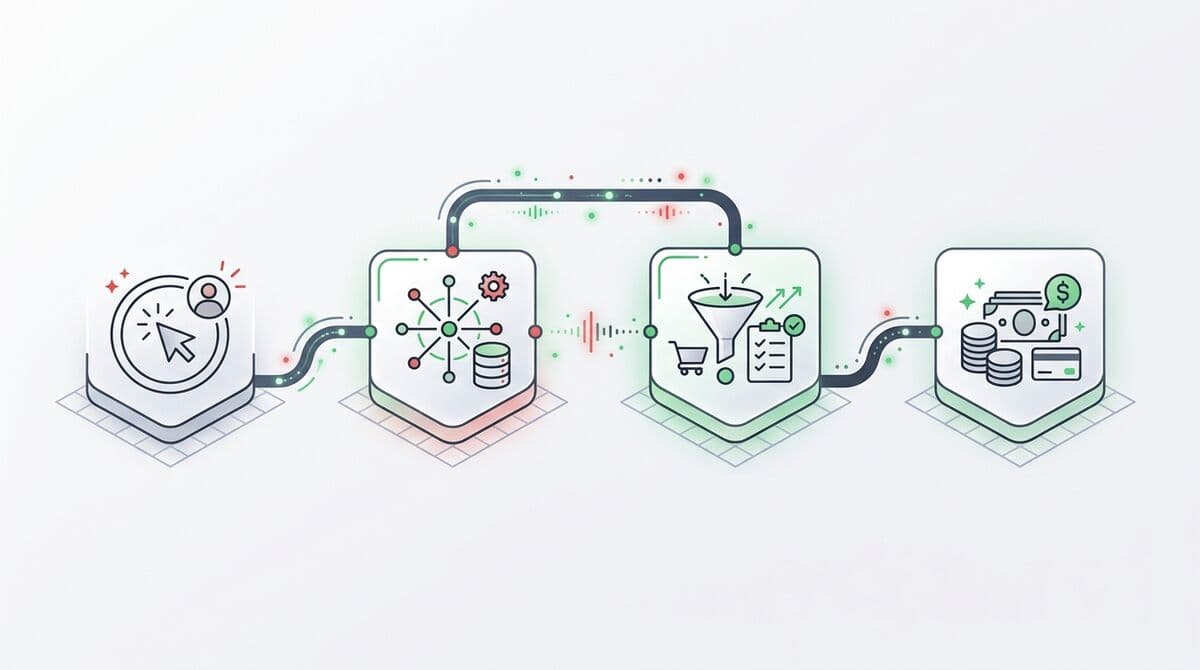
The Affiliate Tracking Lifecycle
Connect Payment Processor
Stripe OAuth in 10 seconds
Create Your Program
Name, commission rate, terms
Customize Portal
Logo, colors, custom domain
Invite Affiliates
Share signup link or invite by email
Track & Pay
Automated tracking and payouts
Affiliate tracking is the technology that connects a partner's marketing effort to a measurable business outcome — usually a sale or signup. Without reliable tracking, there is no way to know which affiliate drove which customer, and the entire affiliate model collapses. Understanding the tracking lifecycle is essential for anyone running or joining an affiliate program.
The lifecycle has six distinct stages: link generation, click tracking, identity binding, conversion detection, commission calculation, and payout processing. Each stage depends on the previous one, and a failure at any point breaks the attribution chain. Modern server-side tracking platforms like Icodrip automate most of these stages, but understanding the mechanics helps you optimize your program and troubleshoot issues.
Let us walk through each stage in detail, using a typical SaaS affiliate program as our example. Imagine you run a project management tool with a $49/month subscription, and you offer affiliates a 25% recurring commission for every customer they refer.
Stage 1: Click Tracking
Live Click Feed
Livepartner_sarah🇺🇸 US/pricingdev_mike🇬🇧 UK/featuresblog_jenny🇩🇪 DE/integrationsyt_techrev🇨🇦 CA/pricingnewsletter_j🇫🇷 FR/Everything begins with a click. When an affiliate promotes your product, they share a unique link that contains their referral identifier. This link might look like yourapp.com/?ref=partner123 or yourapp.com/?via=partner123. Some platforms use subdirectory-based links like yourapp.com/ref/partner123 or custom short domains.
When a visitor clicks this link, the tracking platform intercepts the request and records several pieces of data:
- Referral Code: The affiliate's unique identifier, extracted from the URL parameter.
- Timestamp: The exact time of the click, used for attribution windows and time-decay models.
- IP Address: Used for fraud detection (velocity checks, geographic analysis) and as a secondary attribution signal.
- User Agent: The visitor's browser and operating system, useful for analytics and fraud detection.
- Referrer URL: The page the visitor came from, which tells you where the affiliate placed the link.
- UTM Parameters: Any campaign tracking parameters attached to the link.
The click registration must be fast — ideally under 50 milliseconds — because the visitor is waiting to be redirected to your site. Slow redirects hurt conversion rates and frustrate visitors. This is why high-performance platforms deploy click tracking on edge functions close to the visitor's geographic location.
After recording the click, the platform redirects the visitor to your website. At this point, the referral data exists server-side, ready to be matched when the visitor converts.
Stage 2: Identity Binding — Connecting Visitors to Affiliates
Click tracking captures the initial interaction, but identity binding is what creates a durable link between the visitor and the affiliate. This is the stage where traditional cookie-based tracking and modern server-side tracking diverge most significantly.
In cookie-based systems, identity binding means dropping a cookie in the visitor's browser. The cookie stores the affiliate's referral code and an expiration date (typically 30-90 days). When the visitor later returns and makes a purchase, the platform reads the cookie and attributes the sale.
In server-side systems, identity binding happens at the application level. When the visitor lands on your site with a referral parameter in the URL, your application stores that referral code alongside the visitor's session or user record. If the visitor creates an account, the referral code is permanently attached to their user profile in your database.
Server-side binding is more reliable because it survives cookie clearing, browser switching, and device changes. Once the referral code is stored in your user database, it persists until the customer is attributed — whether that takes 5 minutes or 5 months.
Some platforms also support secondary binding signals like email matching or IP-based attribution as fallbacks. However, the primary binding mechanism should always be a first-party data point (like a URL parameter stored with the user record) rather than a third-party cookie.
Stage 3: Conversion Detection
"type": "invoice.paid",
"customer": "cus_Qk8x...",
"amount_paid": 14900,
"currency": "usd",
"metadata": {
"ref_code": "partner_sarah"
}
}
Conversion detection is the process of recognizing when a referred visitor takes a desired action — subscribing, purchasing, upgrading, or completing a trial. This is where the accuracy of your tracking system matters most.
There are several methods for detecting conversions:
- Webhook-Based Detection (Recommended): Your payment processor (Stripe, Paddle, LemonSqueezy) sends a webhook event when a payment succeeds. The tracking platform receives this webhook, extracts the customer information, and matches it to a stored referral. This is the most accurate method because it relies on authoritative payment data.
- JavaScript Pixel: A tracking pixel fires on your confirmation page when a conversion occurs. This method is less reliable because ad blockers can prevent the pixel from firing, and page navigation issues can cause the confirmation page to load without the pixel executing.
- API-Based Detection: Your application calls the tracking platform's API directly when a conversion occurs. This offers control similar to webhooks but requires custom integration work.
- Postback URL: A server-to-server callback that notifies the tracking platform when a conversion event fires on your backend. Similar to webhooks but initiated by your application rather than your payment processor.
For SaaS companies, webhook-based detection is the gold standard. When Stripe fires an invoice.paid event, you know with certainty that real money changed hands. This eliminates false positives from trial signups that never convert, failed payment attempts, and fraudulent transactions. Icodrip's native integrations handle webhook verification, deduplication, and processing automatically.
Stage 4: Commission Calculation
Commission Calculator
Sale Price
$149
/month
Commission Rate
30%
percentage
Commission
$44.70
/month recurring
Once a conversion is detected and attributed to an affiliate, the platform calculates the commission. Commission structures vary widely, and your tracking platform needs to support the model you have chosen:
- Percentage-Based: The affiliate earns a percentage of the sale amount. For SaaS, this typically ranges from 15-30%. On a $49/month subscription with a 25% commission, the affiliate earns $12.25 per month.
- Flat-Rate: The affiliate earns a fixed dollar amount per conversion, regardless of the sale amount. Common for lead generation programs (e.g., $50 per qualified signup).
- Tiered: Commission rates increase as the affiliate generates more volume. For example: 20% for the first 10 sales, 25% for 11-50 sales, and 30% for 50+ sales in a month.
- Recurring: The affiliate continues to earn commissions on subscription renewals. This can be lifetime (the affiliate earns for as long as the customer pays) or time-limited (e.g., 12 months of recurring commissions).
The commission calculation must also handle edge cases: What happens when a customer upgrades from a $49 to a $99 plan? The affiliate should earn the higher commission. What about downgrades? The commission should adjust accordingly. Refunds? The commission should be clawed back. Chargebacks? Same thing.
These edge cases are where many affiliate platforms fail. A robust tracking platform processes every payment lifecycle event — not just the initial conversion — and adjusts commissions accordingly. This is particularly important for SaaS businesses where customer lifetime value plays out over months or years. Read more about commission structures and how to set rates that attract top partners.
Stage 5: Payout Processing
The final stage of the tracking lifecycle is getting money to your affiliates. Payout processing involves aggregating earned commissions, applying any minimum thresholds, processing the payment, and generating tax documentation.
Common payout methods include:
- Stripe Connect: Direct bank transfers via Stripe's infrastructure. Fast, reliable, and supports 40+ countries. Affiliates connect their bank account once and receive payments automatically.
- PayPal Mass Pay: Batch payments to multiple affiliates via PayPal. Widely supported but carries fees (2-5% depending on the country).
- Bank Wire: Traditional wire transfers for high-value payouts. Expensive ($25-50 per wire) and slow (3-5 business days).
- Wise (TransferWise): International transfers with competitive exchange rates. Good for programs with global affiliates.
Most platforms set a minimum payout threshold (e.g., $50 or $100) to avoid processing tiny payments. Payouts are typically processed on a schedule — monthly, bi-weekly, or weekly — with a holding period (usually 30-60 days) to allow for refunds and chargebacks.
Tax compliance is another critical consideration. In the United States, you must collect W-9 forms from domestic affiliates and issue 1099-NEC forms for anyone earning over $600 in a calendar year. International affiliates require W-8BEN forms. Platforms like Icodrip automate much of this process, reducing the administrative burden on your team.
Common Tracking Pitfalls and How to Avoid Them
Even with the best tracking platform, there are common mistakes that can undermine your affiliate program's attribution accuracy:
- Not Storing the Referral Code at Signup: If your application does not capture and store the referral parameter when a user creates an account, you lose the attribution forever. Always persist the referral code to your user database during registration.
- Using Client-Side-Only Tracking: JavaScript-based tracking is vulnerable to ad blockers, slow page loads, and browser restrictions. Always implement server-side tracking as your primary method, with client-side as a supplementary signal.
- Ignoring Subscription Lifecycle Events: Tracking only the initial conversion and ignoring renewals, upgrades, and refunds leads to inaccurate commission calculations. Configure your webhook integration to process all relevant payment events.
- Setting Attribution Windows Too Short: SaaS purchases often involve long evaluation periods. A 7-day cookie window will miss conversions from enterprise buyers who take weeks to evaluate and purchase. Use 60-90 day windows or, better yet, server-side tracking with no expiration.
- Not Handling Duplicates: Webhooks can fire multiple times for the same event. Your tracking platform must deduplicate events using the event ID to prevent double-counting commissions.
- Forgetting Cross-Domain Tracking: If your marketing site and application live on different domains, ensure the referral parameter is passed correctly during the redirect.
By understanding the full tracking lifecycle and avoiding these pitfalls, you can build an affiliate program that accurately attributes every conversion and keeps your partners happy and motivated. Get started with Icodrip to implement server-side tracking in minutes.
Frequently Asked Questions
Related Articles
Server-Side vs Cookie-Based Affiliate Tracking: The Complete Guide
Discover the key differences between server-side and cookie-based affiliate tracking, why cookies are failing, and how server-side tracking delivers 100% attribution accuracy.
TrackingAffiliate Attribution Models Explained: First-Click, Last-Click, and Beyond
Understand the different attribution models used in affiliate marketing — first-click, last-click, linear, time-decay, and position-based — and which is best for SaaS.
Ready to launch your affiliate program?
Start tracking referrals in 2 minutes. Free plan available.
Start Free