Affiliate Commission Structures Explained: Types, Rates & Examples
Understand the different affiliate commission models — CPA, CPS, CPL, recurring, tiered, and hybrid — with benchmarks and examples to help you choose the right structure.
What Are Affiliate Commission Structures?
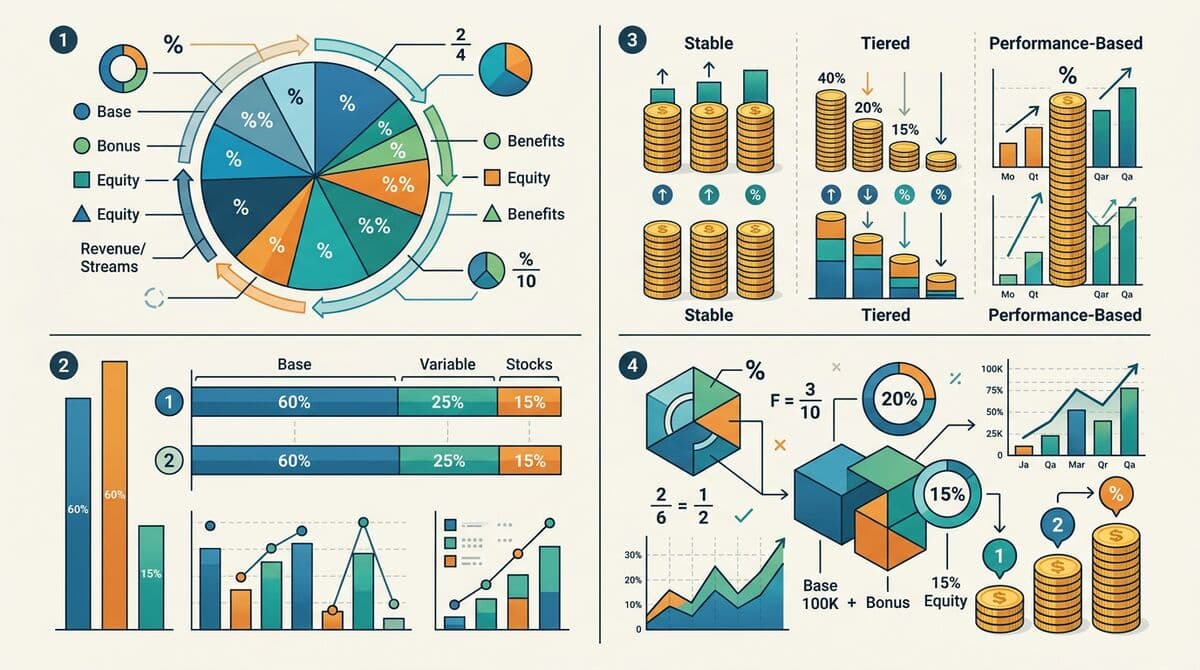
An affiliate commission structure defines how and how much you pay affiliates for the conversions they generate. It is the financial backbone of your affiliate program — the mechanism that motivates partners to promote your product and determines the economics of your entire program.
Choosing the right commission structure is a balancing act. You need a structure that is attractive enough to recruit and retain quality affiliates, sustainable enough to maintain healthy margins, and aligned enough with your business goals to drive the right kind of customer behavior. A poorly designed structure either fails to attract affiliates or erodes your profitability.
The optimal structure depends on several factors: your business model (subscription vs. one-time purchase), your margins, your competitive landscape, and the type of affiliates you want to attract. A content blogger evaluating products needs different incentives than a high-volume paid media affiliate, and your structure should reflect those differences.
Types of Commission Structures
Percentage
30% per sale
Best for SaaS
Flat Rate
$50 per signup
Best for leads
Tiered
20% → 30% → 40%
Reward top performers
Recurring
20% monthly
Best for subscriptions
There are six primary commission models, each suited to different business models and affiliate strategies.
Cost Per Acquisition (CPA): You pay a fixed dollar amount for each completed sale or signup. For example, $50 per new customer. CPA is simple to understand and budget for. It works well for businesses with consistent average order values and is easy for affiliates to calculate their potential earnings. The downside is that it does not account for differences in customer value — you pay the same commission whether the customer buys a $29 plan or a $299 plan.
Cost Per Sale (CPS) / Revenue Share: You pay a percentage of the sale amount. For example, 25% of the transaction value. CPS naturally scales with order value, rewarding affiliates who drive higher-value customers. This is the most common model for e-commerce affiliate programs. For SaaS, CPS can be applied to the first payment only or to every recurring payment.
Cost Per Lead (CPL): You pay for qualified leads rather than completed sales. For example, $10 per email signup or $25 per demo request. CPL works well for businesses with longer sales cycles where the conversion happens through a sales team. The risk is attracting low-quality leads, so you need clear qualification criteria.
Recurring Commissions: The affiliate earns a percentage of every recurring payment the referred customer makes, for a defined period or for the customer's lifetime. This model is specifically designed for subscription businesses and is the most popular structure for SaaS affiliate programs. It creates long-term income for affiliates and aligns their incentives with customer retention.
Tiered Commissions: Commission rates increase based on performance thresholds. For example, 20% for the first 10 referrals per month, 25% for 11-50, and 30% for 51+. Tiered structures motivate affiliates to increase their volume and reward your top performers with higher earnings. They also help manage costs by keeping base rates lower.
Hybrid Models: A combination of two or more structures. For example, a $50 CPA bonus on the first sale plus 15% recurring commission on subscription payments. Hybrid models can be very effective at balancing short-term recruitment incentives with long-term revenue sharing, though they are more complex to communicate and manage.
SaaS Commission Rate Benchmarks
One-Time vs Recurring Commission Value
$50
total after 12 months
$600
12x more over 12 months
Understanding industry benchmarks helps you set competitive rates that attract quality affiliates without overpaying. Here is what leading SaaS affiliate programs offer in 2026:
- 20-30% recurring is the standard range for most SaaS affiliate programs. This is the rate that affiliates expect when evaluating new programs to join.
- ConvertKit: 30% recurring commissions for the lifetime of the referred customer. This is considered one of the most generous programs in the email marketing space and has helped ConvertKit build a massive affiliate network.
- Shopify: A 200% one-time bounty based on the merchant's first monthly subscription fee. This high upfront payout attracts affiliates who prefer immediate returns over recurring income.
- HubSpot: $250-$1,000 flat CPA depending on the product tier. This works because HubSpot's products have high enough price points to support substantial affiliate payouts.
- Teachable: 30% recurring commission for up to one year. The time-limited recurring model balances affiliate incentives with long-term economics.
- SEMrush: $200 per new subscription sale plus $10 per free trial signup. This hybrid model rewards both lead generation and completed sales.
The right benchmark for your program depends on your customer lifetime value and margins. A product with $10,000 LTV can afford to pay much more per acquisition than one with $500 LTV. Calculate your maximum allowable commission as a percentage of LTV, then set your rate competitively within your category.
Calculating Sustainable Commission Rates
Tiered Commission Structure
0–10 sales
11–50 sales
51–100 sales
100+ sales
Higher volumes unlock better commission rates, motivating top affiliates
Setting commission rates requires a clear understanding of your unit economics. Here is a framework for calculating a sustainable rate:
Step 1 — Determine Customer Lifetime Value: Calculate the average total revenue a customer generates before churning. For SaaS, this is average monthly revenue divided by monthly churn rate. If your average customer pays $80/month and your monthly churn is 4%, your LTV is $80 / 0.04 = $2,000.
Step 2 — Calculate Gross Margin on LTV: Multiply LTV by your gross margin. If your gross margin is 80%, the gross profit per customer is $2,000 x 0.80 = $1,600.
Step 3 — Set Maximum Acquisition Cost: Determine the maximum amount you are willing to spend to acquire a customer. Most SaaS companies target a CAC:LTV ratio of 1:3 or better. With $1,600 gross profit, a 1:3 ratio means your maximum CAC is approximately $533.
Step 4 — Translate to Commission Rate: If you offer 25% recurring commissions, the total commission paid over the customer lifetime is $2,000 x 0.25 = $500. This falls within your maximum CAC of $533, making it sustainable.
Step 5 — Validate Against Competitors: Compare your calculated rate against competitors in your category. If your sustainable rate is significantly below the market average, you may need to find other ways to make your program attractive — better conversion rates, higher EPC, superior affiliate support, or bonus incentives.
Remember that commission costs are not your only affiliate program expense. Factor in the cost of the tracking platform, affiliate management time, and marketing materials when calculating total program ROI.
Commission Structure Examples by Industry
Different industries have developed distinct commission conventions based on their business models, margins, and competitive dynamics.
SaaS / Software: 20-30% recurring commissions are standard. Programs typically offer lifetime or 12-month recurring with monthly payouts. The high margins of software (70-85% gross) support generous commission rates. Cookie windows of 60-90 days account for longer B2B sales cycles.
E-Commerce: 5-15% per sale is typical, with higher rates for digital products and lower rates for physical goods with slim margins. Cookie windows are usually 30 days. Many e-commerce programs use tiered structures to reward volume affiliates.
Financial Services: $50-$500 CPA per qualified lead or account opening. Financial products often have strict compliance requirements that limit promotional methods. Commission rates are high because customer lifetime values are substantial.
Online Education: 20-50% per sale for digital courses and membership sites. Digital education products have near-100% gross margins, supporting very generous commissions. Recurring commissions of 25-40% are common for membership-based education platforms.
Web Hosting: $50-$200 CPA per signup or 100-200% of the first month's payment. Web hosting has high customer lifetime values and strong retention, supporting aggressive upfront payouts. Some hosting companies offer $500+ per enterprise referral.
When launching your affiliate program, research the specific benchmarks in your vertical. Your commission structure needs to be competitive within your category — affiliates actively compare programs and will promote the ones that offer the best earnings potential relative to effort.
Common Commission Structure Mistakes
Even well-intentioned affiliate program managers make structural mistakes that undermine their program's potential. Here are the most common pitfalls to avoid:
Setting Rates Too Low: The most frequent mistake is offering below-market commission rates. If your competitors offer 25% recurring and you offer 10%, quality affiliates will simply promote the competition. Research your category benchmarks and offer rates that are at least competitive, if not slightly above average.
Overly Complex Structures: Commission structures that require a spreadsheet to understand are a red flag for affiliates. If a partner cannot quickly calculate their potential earnings, they are less likely to invest time in promoting your product. Keep your core structure simple and add complexity only where it genuinely serves a strategic purpose.
No Recurring Component: For subscription businesses, offering only one-time commissions is a missed opportunity. Recurring commissions give affiliates a reason to promote your product consistently over time and attract high-quality partners who think long-term. One-time commissions attract hit-and-run affiliates who optimize for quick signups rather than quality referrals.
Ignoring Churn Impact: If you offer recurring commissions, you need to account for customer churn in your financial modeling. High churn rates reduce the effective commission payout over time, which can make your program less attractive than the headline rate suggests. Focus on customer retention as a core part of your affiliate program strategy.
No Performance Incentives: Flat commission rates give top performers no reason to increase their efforts. Implementing even a simple two-tier structure — a base rate and a higher rate for affiliates who exceed a monthly threshold — can significantly increase output from your best partners.
Delayed or Unclear Payouts: Commission structures mean nothing if affiliates do not trust that they will actually be paid. Clearly communicate your payment schedule, maintain minimum payout thresholds that are reasonable (not prohibitively high), and always pay on time. Late payments destroy affiliate trust faster than almost anything else.
Frequently Asked Questions
Related Topics
How to Start an Affiliate Program: Step-by-Step Guide
A comprehensive guide to launching your first affiliate program — from choosing the right model and setting commission rates to recruiting affiliates and measuring success.
recurring commissions affiliateRecurring Commissions: How They Work & Why They Matter
Everything you need to know about recurring affiliate commissions — how they work with subscriptions, lifetime vs time-limited models, handling churn, and implementation best practices.
affiliate program best practicesAffiliate Program Best Practices: 12 Rules for Success
Twelve actionable best practices for running a successful affiliate program — from setting clear terms and competitive rates to fraud prevention, automation, and long-term strategy.
Further Reading
Ready to launch your affiliate program?
Start tracking referrals in 2 minutes. Free plan available.
Start Free