What Is Affiliate Tracking? The Complete Guide
Learn how affiliate tracking works, the different tracking methods available, key metrics to monitor, and how to choose the right tracking platform for your business.
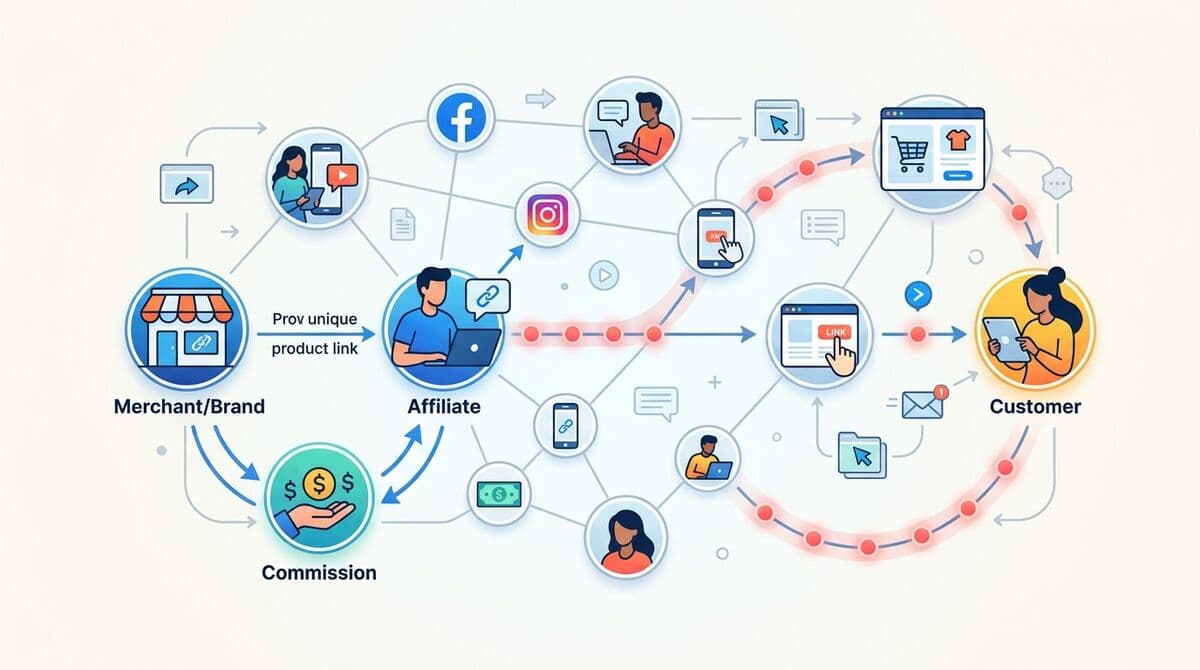
What Is Affiliate Tracking?
Affiliate tracking is the technology and process used to monitor, attribute, and record the activity generated by affiliate partners who promote your product or service. At its core, affiliate tracking answers a simple question: which partner deserves credit for a given sale, signup, or lead?
When a business runs an affiliate program, it recruits partners — bloggers, influencers, content creators, or other companies — who promote the product in exchange for a commission on each conversion they generate. For this model to work, the business needs a reliable way to connect every conversion back to the affiliate who drove it. That connection is what affiliate tracking provides.
Modern affiliate tracking platforms like Icodrip handle this entire attribution chain automatically. They generate unique referral links for each affiliate, record every click on those links, match clicks to downstream conversions, calculate commissions based on your program rules, and generate reports that both you and your affiliates can trust.
Without accurate tracking, an affiliate program cannot function. Affiliates will not promote a product if they cannot verify that their referrals are being counted. And businesses cannot justify paying commissions without proof that the affiliate actually drove the conversion. Tracking is the foundation that makes the entire affiliate ecosystem work.
How Affiliate Tracking Works: From Click to Commission
How Server-Side Tracking Works
User clicks referral link
Icodrip logs click + ref code
User makes purchase
Payment webhook sent to Icodrip
Commission calculated
The affiliate tracking process follows a clear chain of events that starts when a potential customer clicks an affiliate link and ends when a commission is recorded. Understanding this flow is essential for anyone managing or participating in an affiliate program.
- Step 1 — The Click: An affiliate shares a unique referral link, such as
yourapp.com/?ref=partner123. When a visitor clicks this link, the tracking platform records the click along with metadata like the timestamp, the visitor's general location, their device type, and the referring page. This click is the starting point of the attribution chain. - Step 2 — Visitor Identification: After recording the click, the platform needs to remember which affiliate referred this visitor. Traditionally, this was done by placing a cookie in the visitor's browser. Modern server-side tracking platforms instead store the referral information on the server and pass it to your application via URL parameters, which your app then stores alongside the user record during signup.
- Step 3 — The Conversion: When the visitor takes a desired action — making a purchase, starting a trial, or subscribing to a plan — this event is reported to the tracking platform. With server-side tracking, this typically happens via a webhook from your payment processor. The platform matches the conversion to the original click using the stored referral data.
- Step 4 — Commission Calculation: Once the conversion is matched to an affiliate, the platform calculates the commission based on your program rules. This could be a flat fee per conversion, a percentage of the sale amount, or a recurring percentage of subscription revenue. The commission is then recorded and made visible to both the merchant and the affiliate.
This entire flow — from click to commission — can happen in seconds for immediate purchases, or it can span days or weeks for longer sales cycles. The tracking platform maintains the attribution throughout, ensuring that affiliates receive credit no matter how long the customer takes to convert.
Types of Affiliate Tracking
Live Click Feed
Livepartner_sarah🇺🇸 US/pricingdev_mike🇬🇧 UK/featuresblog_jenny🇩🇪 DE/integrationsyt_techrev🇨🇦 CA/pricingnewsletter_j🇫🇷 FR/There are several methods used to track affiliate referrals, each with its own strengths and limitations. The method you choose has a direct impact on tracking accuracy, privacy compliance, and implementation complexity.
Cookie-Based Tracking is the oldest and most widely used method. When a visitor clicks an affiliate link, a cookie is stored in their browser containing the affiliate's identifier. If the visitor later makes a purchase, the platform reads the cookie to determine which affiliate gets credit. The main advantage is simplicity — you just add a JavaScript snippet to your site. The drawbacks are significant: cookies are blocked by ad blockers, limited by browser privacy features like Safari ITP and Firefox ETP, and require GDPR consent banners that many users decline.
Server-Side Tracking moves the attribution logic from the browser to the server. Instead of relying on cookies, the referral data is stored in your backend database and conversions are reported via webhooks from your payment processor. This approach is immune to ad blockers and browser privacy restrictions, delivers near-perfect accuracy, and works seamlessly across devices. It requires integration with your payment processor but modern platforms make this straightforward.
Pixel Tracking uses invisible images or JavaScript pixels embedded on confirmation pages to fire conversion events. When a customer completes a purchase and lands on the thank-you page, the pixel fires and reports the conversion. This method is simpler than server-side integration but shares many of the same vulnerabilities as cookie tracking — ad blockers can prevent the pixel from loading, and the conversion is lost if the customer does not reach the confirmation page.
Postback URL Tracking is a server-to-server method commonly used in performance marketing networks. When a conversion occurs, your server sends an HTTP request to the affiliate network's postback URL with the transaction details. This is similar to webhook-based tracking and shares its accuracy advantages, though it typically requires more manual implementation.
For SaaS businesses with subscription revenue, server-side tracking via webhooks is the clear winner. It handles recurring payments automatically, cannot be blocked by browsers, and provides the accuracy needed to build trust with high-value affiliate partners.
Key Affiliate Tracking Metrics
Effective affiliate tracking goes beyond simply recording conversions. A comprehensive tracking platform measures a range of metrics that help you understand the health and performance of your affiliate program.
- Click-Through Rate (CTR): The percentage of people who see an affiliate's link and actually click on it. A low CTR might indicate poor placement, weak calls to action, or an audience mismatch. Typical affiliate CTRs range from 1% to 5%, depending on the channel and content type.
- Conversion Rate: The percentage of clicks that result in a desired action. This metric tells you how well your landing pages perform for affiliate traffic. If your conversion rate is significantly lower for affiliate traffic than for other channels, you may need to optimize your landing pages or re-evaluate affiliate quality.
- Earnings Per Click (EPC): The average revenue generated per affiliate click. EPC is calculated by dividing total commissions by total clicks. This is the single most important metric for affiliates when deciding whether to promote your product — higher EPC programs attract better partners.
- Average Order Value (AOV): The average transaction value from affiliate-referred customers. Tracking AOV by affiliate helps identify which partners drive higher-value customers and which may be attracting bargain hunters or low-intent traffic.
- Customer Lifetime Value (LTV): For SaaS companies, this is the total revenue a customer generates over their entire relationship with your product. Tracking LTV by referral source helps you determine whether affiliate-acquired customers are as valuable as those from other channels, and whether your commission rates are sustainable.
- Refund and Churn Rate: The percentage of affiliate-referred transactions that are later refunded or cancelled. High refund rates from specific affiliates can indicate misleading promotion or low-quality traffic, and may warrant investigation or removal from the program.
Choosing an Affiliate Tracking Platform
Selecting the right tracking platform is one of the most consequential decisions you will make when launching an affiliate program. The platform you choose determines your tracking accuracy, your affiliates' experience, and your operational overhead. Here are the key factors to evaluate:
Tracking Method: Does the platform use cookie-based tracking, server-side tracking, or both? For SaaS businesses, server-side tracking is essential for accurate recurring commission attribution. Platforms that rely solely on cookies will miss a growing percentage of conversions as browser privacy restrictions tighten.
Payment Processor Integration: Your tracking platform must integrate with your payment stack. If you use Stripe, look for platforms with native Stripe webhook integration that can automatically process subscription events including renewals, upgrades, downgrades, and refunds.
Affiliate Experience: Your affiliates need a clean portal where they can view their performance, access marketing materials, and track their earnings. A poor affiliate experience leads to lower engagement and higher churn among your partners.
Fraud Detection: Look for platforms that include built-in fraud detection — identifying suspicious click patterns, duplicate conversions, self-referrals, and other abuse vectors. Manual fraud review does not scale.
Pricing Model: Affiliate platforms typically charge a monthly subscription, a percentage of payouts, or both. Percentage-based fees can become very expensive as your program scales. Flat monthly pricing provides cost predictability. Icodrip charges a flat monthly fee with 0% payout fees, which becomes increasingly cost-effective as your program grows.
API and Extensibility: If you plan to build custom workflows, integrate with your CRM, or automate affiliate management tasks, you need a platform with a comprehensive API. Check whether the API supports everything you might need — affiliate creation, commission management, reporting, and payout automation.
Getting Started with Affiliate Tracking
Connect Payment Processor
Stripe OAuth in 10 seconds
Create Your Program
Name, commission rate, terms
Customize Portal
Logo, colors, custom domain
Invite Affiliates
Share signup link or invite by email
Track & Pay
Automated tracking and payouts
If you are ready to implement affiliate tracking for your business, here is a practical roadmap to get started:
Define your goals. Before choosing a platform or setting commission rates, clarify what you want your affiliate program to achieve. Are you looking to acquire new customers? Increase brand awareness? Drive trial signups? Your goals will shape every subsequent decision, from commission structure to affiliate recruitment strategy.
Choose your tracking method. For SaaS and subscription businesses, server-side tracking is the right choice. For e-commerce with one-time purchases, cookie-based tracking may suffice, though server-side is still more accurate. Consider your audience's browser distribution and privacy tool usage when making this decision.
Set up your platform. Sign up for a tracking platform, connect your payment processor, and configure your first affiliate program. With modern platforms, this can be done in minutes. You will need to define your commission structure, cookie duration (if applicable), and attribution window.
Create affiliate assets. Prepare the materials your affiliates will need: branded banners, email templates, product screenshots, and key selling points. The easier you make it for affiliates to promote your product, the more effective they will be.
Recruit your first affiliates. Start with your existing customers — they already know and trust your product. Reach out to bloggers and content creators in your niche. Consider listing your program in affiliate directories and marketplaces. Quality matters more than quantity in the early stages.
Monitor and optimize. Once your program is running, track the key metrics described above. Identify your top-performing affiliates and learn from their strategies. Adjust commission rates, provide better assets, and communicate regularly with your partners to keep them engaged and productive.
Affiliate tracking is not a set-it-and-forget-it system. The most successful programs are actively managed, continuously optimized, and built on a foundation of accurate, reliable tracking technology.
Frequently Asked Questions
Related Topics
Server-Side vs Client-Side Tracking: What's the Difference?
A detailed comparison of server-side and client-side affiliate tracking — how each works, their limitations, and which approach delivers better accuracy in a privacy-first world.
cookieless affiliate trackingCookieless Affiliate Tracking: The Future of Attribution
Understand why third-party cookies are disappearing, how browser privacy changes impact affiliate tracking, and what cookieless alternatives ensure accurate attribution going forward.
affiliate fraud preventionAffiliate Fraud Prevention: Types, Detection & Protection
Learn about the most common types of affiliate fraud, how to detect suspicious activity, and the tools and strategies to protect your affiliate program from abuse.
Further Reading
Ready to launch your affiliate program?
Start tracking referrals in 2 minutes. Free plan available.
Start Free