Referral Program vs Affiliate Program: What's the Difference?
A clear breakdown of the differences between referral programs and affiliate programs — who participates, how compensation works, when to use each, and how to run both together.
What Is a Referral Program?
Connect Payment Processor
Stripe OAuth in 10 seconds
Create Your Program
Name, commission rate, terms
Customize Portal
Logo, colors, custom domain
Invite Affiliates
Share signup link or invite by email
Track & Pay
Automated tracking and payouts
A referral program is a structured system where existing customers recommend a product or service to people they know — friends, colleagues, or professional contacts — in exchange for a reward. The referrer already uses and trusts the product, which makes their recommendation inherently credible. Referral programs leverage word-of-mouth, the most trusted form of marketing, and channel it through a trackable, incentivized framework.
In a typical SaaS referral program, a customer logs into their account, finds a unique referral link or code, and shares it with someone who might benefit from the product. When that person signs up and becomes a paying customer, both the referrer and the new customer often receive a reward — a discount, account credit, free month of service, or a one-time cash bonus.
Referral programs are bilateral by nature: both parties benefit. The referrer gets rewarded for bringing in a new customer, and the referred friend often gets a signup incentive (like 20% off their first month). This two-sided reward structure is what separates referral programs from simple word-of-mouth — it creates a tangible reason for customers to actively share.
Well-known examples include Dropbox (which grew from 100,000 to 4 million users in 15 months largely through its referral program), Slack (which offers account credits for referrals), and Notion (which provides free credits when existing users invite teammates). These programs work because the referrer has genuine experience with the product and their recommendation carries personal trust.
What Is an Affiliate Program?
An affiliate program is a performance-based marketing arrangement where external partners — called affiliates — promote a product to their audience in exchange for a commission on each sale or signup they generate. Unlike referral programs, affiliates do not need to be customers of the product. They are marketers, content creators, bloggers, YouTubers, comparison site operators, or industry influencers who earn money by driving paying customers to your business.
In a SaaS affiliate program, an affiliate applies to join, receives a unique tracking link, and promotes the product through their marketing channels: blog posts, YouTube reviews, email newsletters, social media, comparison articles, or paid advertising. When someone clicks the affiliate's link and eventually becomes a paying customer, the affiliate earns a commission — typically a percentage of the sale or subscription revenue.
Affiliate commissions are usually recurring for SaaS products, meaning the affiliate earns a percentage of every monthly or annual payment the referred customer makes, not just the first one. A 25% recurring commission on a $99/month SaaS product means the affiliate earns $24.75 every month for as long as that customer stays subscribed. This recurring model makes SaaS affiliate programs among the most lucrative in the industry.
Affiliate programs are unilateral: only the affiliate receives compensation. The end customer typically does not get a special discount or bonus for using an affiliate link (though some programs do offer affiliate-exclusive deals). The value exchange is between the company and the affiliate — the company gets a new customer, and the affiliate gets paid for the referral.
Examples of successful SaaS affiliate programs include HubSpot (30% recurring commission), ConvertKit (30% recurring for 24 months), Shopify (up to $150 per referral), and Icodrip itself, which allows any SaaS company to launch and manage their own affiliate program.
Key Differences: Referral Program vs Affiliate Program
Cookie-Based Tracking
Traditional approach
Blocked by ad blockers (30%+ users)
Expires after 7 days (Safari ITP)
Killed by privacy browsers
~70% attribution accuracy
Server-Side Tracking
Icodrip approach
Immune to ad blockers
No cookie expiration
Works on all browsers
~100% attribution accuracy
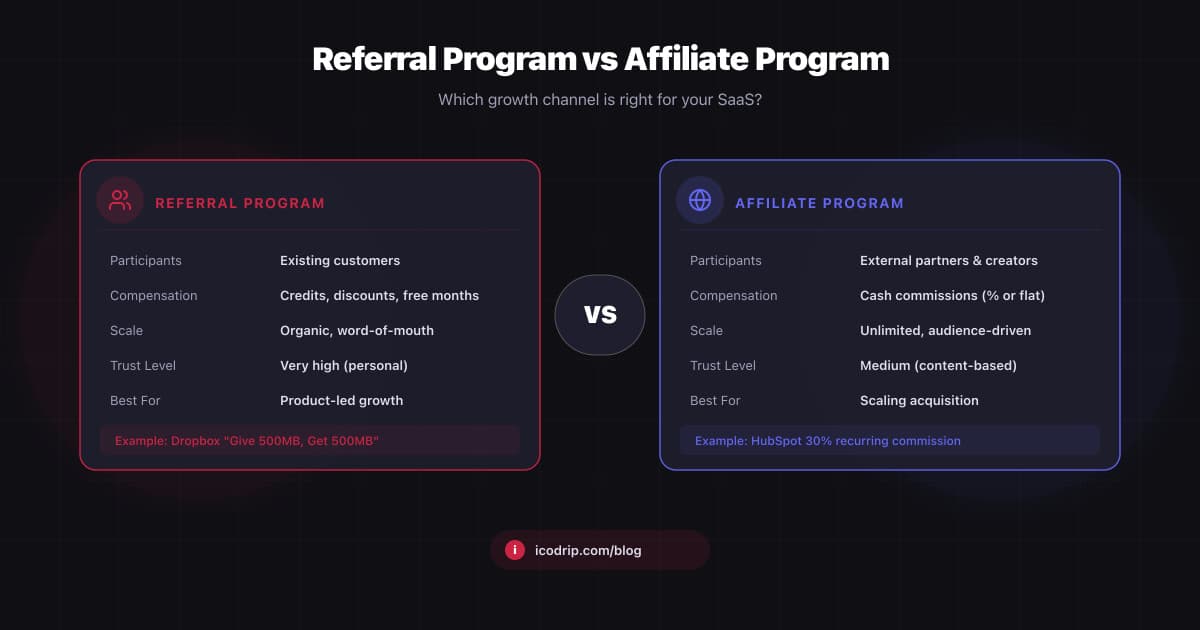
While referral programs and affiliate programs both generate new customers through third-party recommendations, they differ in fundamental ways. Understanding these differences is critical for choosing the right model — or deciding to run both.
| Dimension | Referral Program | Affiliate Program |
|---|---|---|
| Who participates | Existing customers who use the product | External marketers, bloggers, influencers, content creators |
| Relationship to product | First-hand user with personal experience | May never have used the product |
| Audience reach | Personal network (friends, colleagues, contacts) | Public audience (blog readers, YouTube subscribers, email lists) |
| Compensation model | Credits, discounts, free months, small cash bonuses | Percentage-based commissions (often recurring) |
| Reward structure | Bilateral — both referrer and referred person get a reward | Unilateral — only the affiliate is compensated |
| Scale | Limited by customer base size | Scalable through content marketing and SEO |
| Trust signal | High — personal recommendation from someone you know | Medium — expert opinion from a content creator |
| Tracking complexity | Simpler — usually one-time conversion event | More complex — recurring commissions, multi-touch attribution |
| Management effort | Lower — customers self-serve through the product | Higher — recruitment, onboarding, asset creation, relationship management |
| Typical reward value | $10-$50 credit or 1 free month | 20-30% recurring commission (can be $100s/year per referral) |
| Best for | B2C SaaS, products with strong user loyalty | B2B SaaS, products with longer sales cycles and higher LTV |
The core distinction comes down to this: referral programs activate your existing customers as advocates, while affiliate programs recruit external marketers as distribution partners. A referral is a personal endorsement ("I use this and you should too"), while an affiliate promotion is a professional recommendation ("I have reviewed this and here is why it is worth buying").
Both models create new customers through trusted recommendations rather than direct advertising. But they tap into fundamentally different networks and motivations, which is why the most successful SaaS companies often run both simultaneously.
How Compensation Works in Each Model
The way participants get paid is one of the sharpest differences between referral and affiliate programs, and it shapes the behavior you can expect from each channel.
Referral program compensation is designed to be simple and immediate. Common reward structures include:
- Account credits: The referrer gets $25 in account credit for each successful referral, which is applied to their next billing cycle. This is the most common model because it is easy to implement and keeps the customer engaged with the product.
- Free months: "Give a month, get a month" — both the referrer and the new customer get a free month of service. Dropbox popularized this model with free storage, and it works well for SaaS because it reduces churn while acquiring new users.
- Cash bonuses: A flat cash payment ($10-$50) per successful referral. Less common in SaaS but used when the company wants to maximize referral volume.
- Tiered rewards: Increasing rewards based on the number of referrals — $25 for the first, $50 for the fifth, $100 for the tenth. This gamifies the referral process and motivates power users.
Referral rewards are almost always one-time. The customer gets their credit or bonus once, and that is it. This keeps the program simple and cost-predictable.
Affiliate program compensation is more sophisticated, especially for SaaS:
- Percentage recurring commissions: The most common model for SaaS — 20-30% of each payment the referred customer makes, for as long as they remain a subscriber (or for a defined period like 12 or 24 months). This is the gold standard because it aligns affiliate incentives with customer retention.
- Flat-rate commissions: A fixed dollar amount per conversion ($50-$200 per signup). Simpler to manage but does not incentivize affiliates to refer customers to higher-tier plans.
- Tiered commission structures: Higher-performing affiliates earn higher commission rates. For example, 20% for affiliates generating 1-10 sales/month, 25% for 11-50, and 30% for 50+. This rewards your best partners and motivates growth.
- Hybrid models: A one-time bonus ($100) plus an ongoing recurring commission (15%). This gives affiliates an immediate payout while maintaining long-term incentive alignment.
The key difference is that affiliate commissions are ongoing revenue for the partner. A productive affiliate earning 25% recurring commissions on 50 referred customers paying $99/month earns $1,237.50 per month in passive income. This is a meaningful business, which is why professional affiliates invest significant effort in content creation and promotion. Learn more about commission structures that drive affiliate performance.
When to Choose a Referral Program
Affiliate Program Metrics
MRR from Affiliates
$12.4K
+23% vs paid adsCAC via Affiliates
$23
-41% vs paid adsLTV of Referred Users
$2,100
+18% vs paid adsPayback Period
1.1 mo
-62% vs paid adsA referral program is the right choice when your growth strategy depends on leveraging your existing customer base. Here are the scenarios where referral programs deliver the strongest results:
- You have a loyal customer base with high NPS: If your customers genuinely love your product (NPS of 40+), a referral program gives them a structured way to share that enthusiasm. Customers who would recommend you anyway will do it more frequently when there is a reward attached.
- Your product has a viral loop: Products where the value increases with more users — team collaboration tools, communication platforms, project management software — benefit enormously from referral programs. Each new user makes the product better for existing users, creating a natural incentive to refer.
- You sell to individuals or small teams: B2C and prosumer SaaS products where purchasing decisions are made quickly and individually are ideal for referral programs. The recommendation happens in a casual conversation: "Hey, I use this tool and it is great — here is a link for a free month."
- You want low-cost, high-trust acquisition: Referral programs typically cost $10-$50 per acquired customer (the reward value), which is a fraction of paid acquisition costs. And because the recommendation comes from a trusted personal contact, referred customers convert at 3-5x the rate of other channels.
- You are early-stage with limited marketing budget: A referral program can be launched with minimal investment. You do not need to recruit external partners, create marketing assets, or manage an affiliate network. Your customers do the marketing for you.
Referral programs work best when the product has natural word-of-mouth potential. If your customers are already telling friends about you, a referral program amplifies that behavior. If they are not, a referral program alone will not create it — you need to fix the product experience first.
When to Choose an Affiliate Program
An affiliate program is the right choice when you want to scale customer acquisition beyond your existing user base by tapping into external audiences. Here are the scenarios where affiliate programs excel:
- You sell a B2B SaaS product with high LTV: Products with annual contract values above $500 can afford generous recurring commissions that attract serious affiliates. A 25% commission on a $199/month product pays the affiliate nearly $600/year per referral — enough to justify writing in-depth reviews, comparison articles, and tutorial content.
- Your product has a content-friendly niche: Affiliates need to create content that ranks in search engines and attracts an audience. Products in niches with high search volume — email marketing, project management, CRM, analytics, design tools — attract more affiliates because there is an audience to reach.
- You want to dominate search for comparison and review keywords: Affiliates create content like "Best [category] tools in 2026" and "[Your product] vs [Competitor]" articles. This content drives bottom-of-funnel traffic from people actively searching for a solution. Having 20+ affiliates creating this content gives you outsized search visibility.
- You want scalable, performance-based marketing: Unlike referral programs, which are limited by your customer base size, affiliate programs can scale to hundreds or thousands of partners. Each affiliate brings their own audience, and you only pay when they deliver results.
- You have a mature product with a clear value proposition: Affiliates need to be able to explain your product convincingly to an audience that has never used it. This requires clear messaging, strong differentiation, and ideally social proof (customer logos, case studies, review scores).
Affiliate programs require more management effort than referral programs — you need to recruit affiliates, provide marketing assets, approve applications, and manage payouts. But the return on that investment is significant: SaaS companies with active affiliate programs typically see 15-30% of new customer acquisitions come through the affiliate channel within 12-18 months.
If you are considering launching an affiliate program for your SaaS, our complete guide to starting a SaaS affiliate program walks through every step from platform selection to affiliate recruitment.
Can You Run Both? Yes — And You Should
The referral vs affiliate question is not an either-or decision. The most successful SaaS companies run both programs simultaneously, because they serve different audiences and different stages of growth.
Here is how they complement each other:
- Referral programs capture warm leads: Your customers' personal networks are full of people who trust their recommendations. A referral program captures these high-intent, high-trust leads that would never come through a blog post or YouTube review.
- Affiliate programs capture cold traffic: People searching "best project management tool 2026" do not know anyone who uses your product. They find it through affiliate content — reviews, comparisons, tutorials. An affiliate program captures these research-stage buyers.
- Different funnel stages: Referral programs work at the bottom of the funnel (someone ready to try because a friend recommended it). Affiliate programs work across the entire funnel — from awareness (blog posts) to consideration (comparison articles) to decision (reviews with special offers).
- Different cost structures: Referral rewards are typically $10-$50 one-time. Affiliate commissions are 20-30% recurring. Running both gives you a blended CAC that is lower than either channel alone at scale, because each program optimizes for a different audience segment.
- Compound growth effect: As affiliates bring in new customers, those customers become potential referrers. A customer acquired through an affiliate blog post might refer three colleagues through your referral program. The two channels feed each other.
In practice, the implementation is straightforward. You set up separate programs within your tracking platform — one for customer referrals (with credit-based rewards and simple tracking) and one for affiliate partners (with percentage-based recurring commissions and a full affiliate portal). Each program has its own terms, commission structure, and reporting.
Icodrip is built to support both models within a single platform. You can create multiple programs per organization — a referral program for customers with account credit rewards, and an affiliate program for external partners with recurring percentage commissions. Each program has its own unique links, commission rules, and portal experience, all managed from one dashboard.
Real Examples: How SaaS Companies Use Each Model
Connect Payment Processor
Stripe OAuth in 10 seconds
Create Your Program
Name, commission rate, terms
Customize Portal
Logo, colors, custom domain
Invite Affiliates
Share signup link or invite by email
Track & Pay
Automated tracking and payouts
Looking at how successful SaaS companies structure their referral and affiliate programs reveals clear patterns about when each model works best.
Dropbox — Referral Program Pioneer: Dropbox's referral program is one of the most cited growth case studies in SaaS history. Existing users could invite friends and both parties received 500MB of extra storage (later increased to 1GB). This bilateral reward, combined with a product where more storage was universally valuable, drove Dropbox from 100,000 to 4 million users in 15 months — a 3,900% growth rate. The key insight: the reward (storage) was directly tied to product value, making the referral feel like a feature, not a promotion.
HubSpot — Affiliate Program at Scale: HubSpot runs one of the most successful B2B SaaS affiliate programs, offering 30% recurring commissions for up to one year. Their affiliates are primarily marketing bloggers, agency owners, and educators who create content like "HubSpot vs Salesforce" and "Best CRM for small business." With an average contract value of $10,000+/year, a single affiliate referral can earn the partner $3,000 in commissions. HubSpot's program works because the product has high LTV, a content-rich niche, and clear differentiation.
ConvertKit — Both Models in Parallel: ConvertKit runs a referral program for existing customers (account credit for referrals) alongside an affiliate program for content creators (30% recurring commission for 24 months). The referral program targets their core user base of email marketers who know other email marketers. The affiliate program targets bloggers and YouTubers who create content about email marketing tools. By running both, ConvertKit captures referrals from personal networks and from public content — two entirely different acquisition channels.
Notion — Referral with Viral Loop: Notion's referral program gives both the referrer and the new user $10 in account credit. Because Notion is a team tool, every new user who joins a workspace makes the product more valuable for existing members. This creates a viral loop: each referral increases the product's value, which drives more usage, which drives more referrals.
Shopify — Affiliate Program for Content Domination: Shopify's affiliate program pays up to $150 per merchant referral. Their army of affiliates has created thousands of blog posts, YouTube tutorials, and online courses about starting an e-commerce store with Shopify. This content dominates search results for virtually every e-commerce-related keyword, giving Shopify an enormous organic traffic moat that would be nearly impossible to build through internal content alone.
How Icodrip Handles Both Referral and Affiliate Programs
Icodrip is purpose-built for SaaS companies that want to run referral programs, affiliate programs, or both — from a single platform. Here is how it works in practice:
- Multiple Programs Per Organization: Create separate programs for referrals and affiliates within the same Icodrip account. Each program has its own commission structure, terms, tracking links, and portal. Your customer referral program can offer $25 account credits while your affiliate program offers 25% recurring commissions — both running simultaneously with independent tracking.
- Flexible Commission Structures: Configure any compensation model — flat-rate rewards for referral programs, percentage-based recurring commissions for affiliate programs, tiered structures that reward top performers, or hybrid models that combine upfront bonuses with ongoing commissions. Explore all commission structure options.
- Server-Side Tracking for Both Models: Whether it is a customer sharing a referral link with a colleague or an affiliate embedding a link in a blog post, every referral is tracked server-side with 100% attribution accuracy. No cookies, no lost conversions, no frustrated partners wondering where their commissions went.
- Native Payment Processor Integration: Icodrip connects directly with Stripe, Paddle, LemonSqueezy, and other processors. When a referred customer pays, the conversion is captured automatically via webhook — no manual tracking, no reconciliation, no missed commissions.
- Automated Payouts: For affiliate programs with cash commissions, Icodrip automates the entire payout process — calculating commissions, processing payments, and handling tax documentation. For referral programs with account credits, the reward can be applied automatically.
- White-Label Portal: Give your affiliates a branded portal with your logo, colors, and custom domain. Referral participants can access their link and track results directly within your product, keeping the experience seamless.
- Fraud Prevention: Both referral and affiliate programs are protected by Icodrip's fraud detection system, which identifies self-referrals, cookie stuffing, click fraud, and other manipulation attempts.
The result is a single platform that handles both growth channels without the complexity of managing separate tools. You get unified reporting, consistent tracking, and a streamlined experience for both your customers (referrers) and your external partners (affiliates).
Icodrip plans start at $29/month (free until $1,000/mo tracked revenue) with zero commission fees and zero payout fees, making it cost-effective for companies at any stage — from startups launching their first referral program to established SaaS companies managing hundreds of affiliate partners.
Common Mistakes to Avoid
Whether you are launching a referral program, an affiliate program, or both, these are the pitfalls that derail most SaaS partner programs:
- Making the referral reward too small: A $5 credit on a $99/month product is insulting. Your referral reward should feel meaningful relative to the product's price point. A general rule: offer at least one free month or the equivalent in account credit.
- Setting affiliate commissions too low: Affiliates compare commission rates across programs in your niche. If competitors offer 25-30% recurring and you offer 10%, you will not attract quality partners. Research your competitors' programs and match or exceed their rates.
- Using cookie-based tracking: Cookie-based tracking loses 20-40% of conversions in 2026 due to browser restrictions and ad blockers. Both referral and affiliate partners will lose trust if their dashboards show fewer conversions than expected. Server-side tracking solves this problem completely.
- Neglecting affiliate onboarding: Approving an affiliate and then providing no guidance, assets, or support is a recipe for low activation. Create an onboarding sequence that includes product overview, marketing assets, best-performing promotional strategies, and a point of contact for questions.
- Not promoting the referral program: Burying the referral link in a settings page ensures no one will use it. Promote it in onboarding emails, in-app notifications, post-purchase flows, and support interactions. The best referral programs are visible at every touchpoint where a happy customer might share.
- Treating affiliates as an afterthought: Affiliates are business partners, not a set-and-forget marketing channel. The programs that generate 20%+ of revenue have dedicated affiliate managers who communicate regularly, share product updates, and help top partners optimize their content.
The single biggest mistake is choosing between a referral program and an affiliate program when you should be running both. Each captures a different audience, operates at a different scale, and costs a different amount per acquisition. Together, they create a comprehensive partner-driven growth engine that paid advertising alone cannot match.
Frequently Asked Questions
Related Articles
How to Start a SaaS Affiliate Program: The Complete 2026 Guide
Everything you need to launch a successful SaaS affiliate program — from choosing a platform and setting commission rates to recruiting partners and measuring ROI.
SaaS GrowthAffiliate Commission Structures: How to Set Rates That Attract Top Partners
Explore different commission structures — percentage, flat-rate, tiered, recurring, and hybrid — with SaaS industry benchmarks and strategies for sustainable rates.
SaaS GrowthMeasuring Affiliate Program ROI: The Metrics That Actually Matter
Learn which metrics truly indicate affiliate program health — from CAC and LTV to revenue per affiliate and conversion rates — and how to calculate your real ROI.
Ready to launch your affiliate program?
Start tracking referrals in 2 minutes. Free plan available.
Start Free